
Field Notes
world belongs to words | words do not belong to world

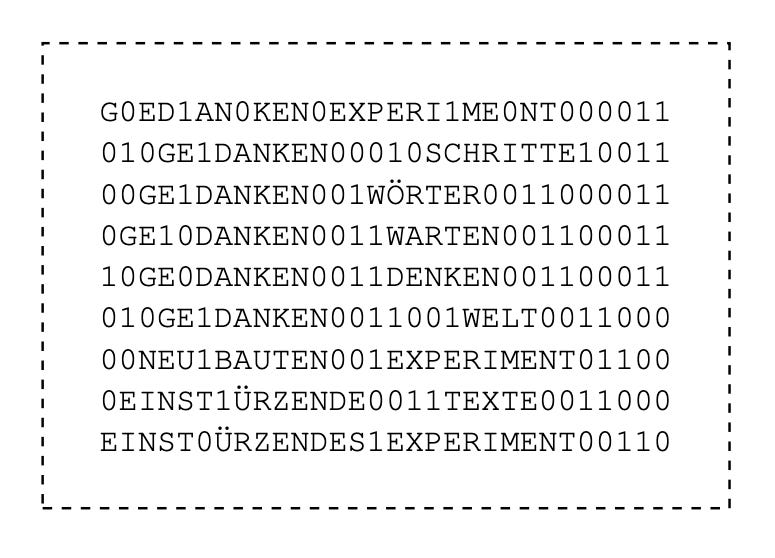
[1] I sometimes suspect that writing begins precisely where communication fails · not after failure · not in response to failure · but inside it · a page covered with unreadable marks is often considered incomplete · yet the opposite may be true · language reaches completion whenever it encounters the limit beyond which it can no longer translate itself into certainty · at that point the sentence is no longer the measured quantity but the unresolved field from which measurement may emerge
[2] a cloud chamber does not reveal a particle · it reveals the consequences of a particle passing through a medium·the distinction matters · reading operates according to a similar principle · one never encounters meaning directly · what appears before the eyes is a chain of traces, condensations, deviations, residues · meaning belongs to the category of inferred objects
[3] the blank page is frequently mistaken for emptiness · in practice it behaves more like a gravitational field · words curve towards it·drawings emerge from it · every mark attempts to negotiate its attraction · the page remains unmoved throughout the process · once the work is complete, the page has lost nothing and gained nothing · only the observer has changed position
[4] when a text becomes unreadable, readers often assume that information has been removed·another possibility exists · the information may have multiplied beyond the capacity of a single interpretative framework · a forest is not less complex than a path because one cannot walk everywhere at once · in certain cases illegibility is not the absence of order but the coexistence of too many orders
[5] the history of writing is usually described as a progressive refinement of signs · less attention is given to the opposite movement · every archive also accumulates erasures, damaged surfaces, missing pages, fragments detached from their original context · one could write an equally legitimate history of literature by following the trajectories of what no longer allows itself to be read
[6] a metric space does not require meaning · it requires relations · two points may be near or distant regardless of what they represent · reading often proceeds in the same manner · long before interpretation begins, words establish neighbourhoods, attractions, exclusions and resonances · sense arrives later and occasionally mistakes itself for the source of the process
[7] wind possesses no alphabet, yet it leaves inscriptions everywhere · snowdrifts, dunes, riverbeds and cloud formations preserve temporary negotiations between matter and turbulence · writing differs less from these phenomena than custom suggests · the principal distinction lies in our insistence on calling one process language and the other nature
[8] a photograph does not capture a frame in time · it shifts the observed phenomenon into a further layer of entropy, namely that of the film or the digital array · between the phenomenon and its inscription lies a narrow territory occupied by memory · most of what survives there is inaccurate · the remarkable fact is not that memory distorts events but that distortion itself remains sufficiently structured to produce narratives and identities
[9] the notion that a text contains meaning resembles the notion that a map contains a landscape · both statements are useful, neither is strictly true · meaning occurs between a document and its reader just as a territory occurs between a map and the body moving through it · remove either side of the relation and the phenomenon disappears
[10] there are pages that function as answers and pages that function as instruments · the former seek to stabilise interpretation · the latter expose interpretation to conditions under which it becomes uncertain, provisional or reversible · asemic writing belongs to the second category · it does not conceal a message · it stages the event through which messages become possible
[11] imagine l’univers : une très fine étendue d’énergie, qui par endroits se déchire et fait matière et forme ces regroupements que nous appelons choses ou êtres, selon leur degré de complexité et d’autonomie · parmi eux, il y a ceux que, par affinité, nous disons vivants · mais c’est une habitude qui sera bientôt abandonnée car tombera la frontière surveillée par ce que certains appellent encore âme, et que d’autres ont maintenue marquée mais dégarnie · dans ce tableau, tout apparaît comme une unique grammaire sans bornes, sur laquelle affleurent des systèmes de signes plus ou moins compliqués qui s’articulent en langues · mais n’est-ce pas justement le propre de la nature complexe de ces êtres que leur saillie parmi les choses, à imposer l’écart du langage, la friction entre les langues, dans la tentative continuellement manquée de recoudre la déchirure ?1
[12] (Dijkstra’s algorithm)—you are not afraid of flying · yet you know you are not a bird · boarding a plane, you do not think you have learned to fly, or worse, that you have turned into a bird · the airplane is not an imitation of flight · it is a different solution
[13] the network as dream · a prompt, a stimulus · then the residue reorganizes itself into text-image · condensation, displacement, no dreamer in charge · over which you lose full control—(talking with Franz, keeper of the castle gate)
[14] (unrelated listing, found nearby)
imagine the universe: a most delicate expanse of energy, which here and there tears and becomes matter and forms those clusters we call things or beings, according to their degree of complexity and autonomy · among these are those that, by affinity, we call living · but this is a habit soon to be abandoned, for the boundary will fall that is guarded by what some still call soul, and others have kept marked but unguarded · in this picture, everything appears as a single boundless grammar, on which surface systems of signs, more or less complicated, that articulate themselves into languages · but is it not proper to the complex nature of these beings, their jutting out among things, to impose the gap of language, the friction between languages, in the ever-failing attempt to mend the tear?
Really good Federico! I have been taking up the subject of asemic writing the last couple of articles. It is dificult to discuss the things for which language is ill suited.