
Field Notes XV-XVI
what turns x into a trace? what remains of x as trace?

what turns x into a trace?
what remains of x as trace?
[15] a trace is residual information in a medium as it interacts with the object of inquiry · the properties of that medium, and the conditions of the experiment, shape what is recorded · object and trace do not coincide: the object may be absorbed, destroyed, or dispersed · its existence in itself—prior to any registration—has no operative status within the trace, since what the trace records is an event irreducible to any other form of access · what was taken as known proves otherwise · one line of the work proceeds from that loss, treating writing itself as loss, as trace · it accepts that what lies behind a name may in fact be unreachable · structure is then privileged over content, and illegibility is recognised not as a failed or partial attempt, but as an autonomous, complete, and primary state · the loop thus closes: language and matter share the same instability · if nature admits a textual reading, writing can be addressed as a theory of measurement · the object we imagine behind, or within, a sign is approached only through further signs—verbal, mathematical, visual, physical, computational—yet none of these coincides with it · each reconstructs, displaces, or models only a part of it · what follows is therefore always improper: we do not investigate objects through signs, but signs through other signs
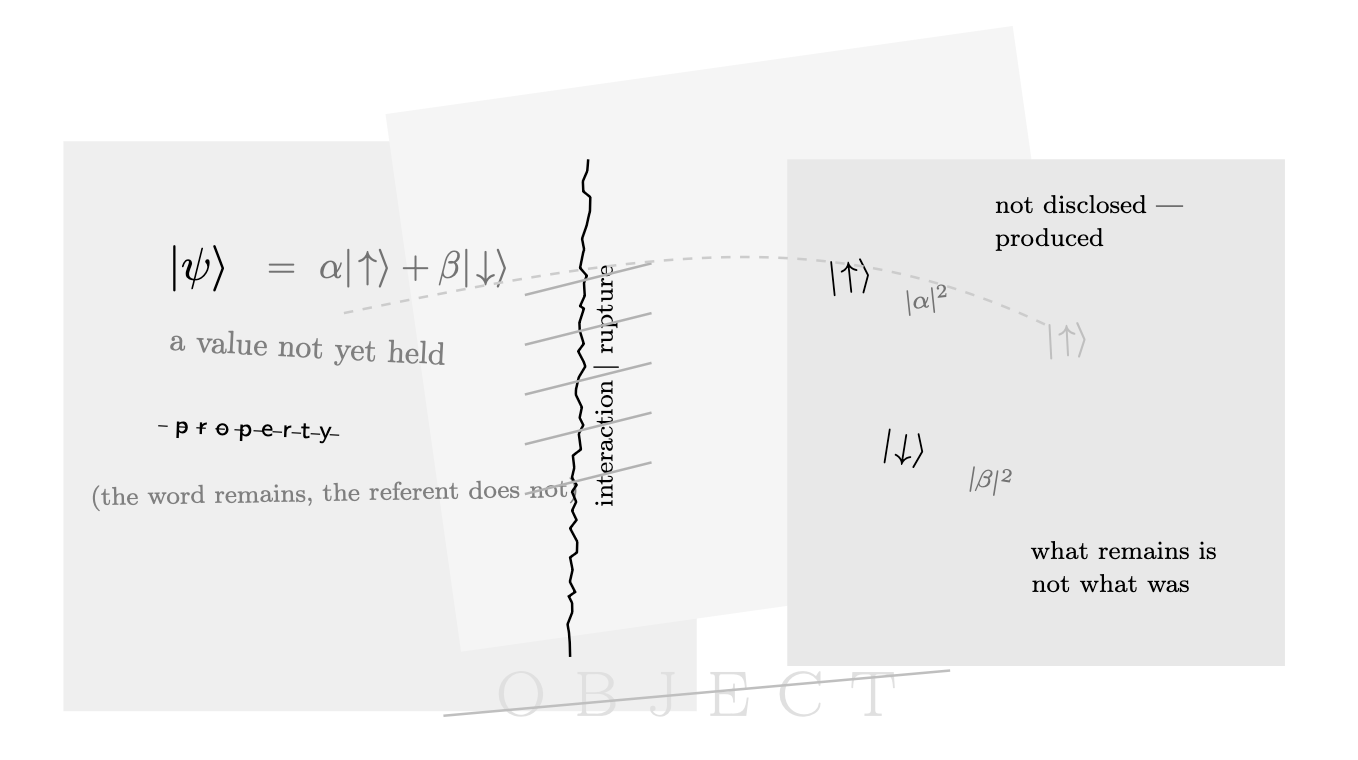
[16] a quantum state does not contain definite values for all observables prior to measurement · before interrogation, the particle is not spinning up, not spinning down—it is not yet anything an instrument could report · the wavefunction does not describe an object with hidden, definite attributes · it describes a distribution of possibilities that resolves into a value only at the moment it interacts with an apparatus · measurement, then, is not the observation of a pre-existing fact · it is the production of one · what we call a state is not a trace disclosing something that was already there—it is the event that gives the thing, for the first time, something to be · superposition is what a system is before it is inscribed by an instrument · once inscribed, it cannot, in practice, be returned to what it was before the inscription · and to measure one property is to render its conjugates constitutively unavailable—not hidden, not awaiting discovery, but made unavailable by the very relation that fixed it · the object was never waiting behind the trace · there was only the possibility of tracing—and a trace, in registering, is what first brings the object into having been anything at all